The web industry sells projects. A site gets scoped, designed, built, launched, invoiced, and handed over, and the relationship is understood to be finished. That framing is convenient for everyone — it makes the work easy to quote and easy to compare — and it quietly misdescribes where most of the value in a website partner actually sits. Not in the launch. In year four, when something looks wrong on a Friday afternoon and the person you call already knows what it is.

We have been doing this from Corvallis, Oregon since 2012. What follows is not a claim that we are pleasanter to work with than the alternative. It is an argument about what accumulates when a provider stays — the specific, unglamorous knowledge that exists only over time — and what that turns out to be worth on the day you need it.
The claim, with names attached
Our about page makes a claim that any studio could write: most of our clients have been with us for five years or more, and some for over a decade. Claims like that are not worth much in truth without examples. Here is the same claim with names attached to it.
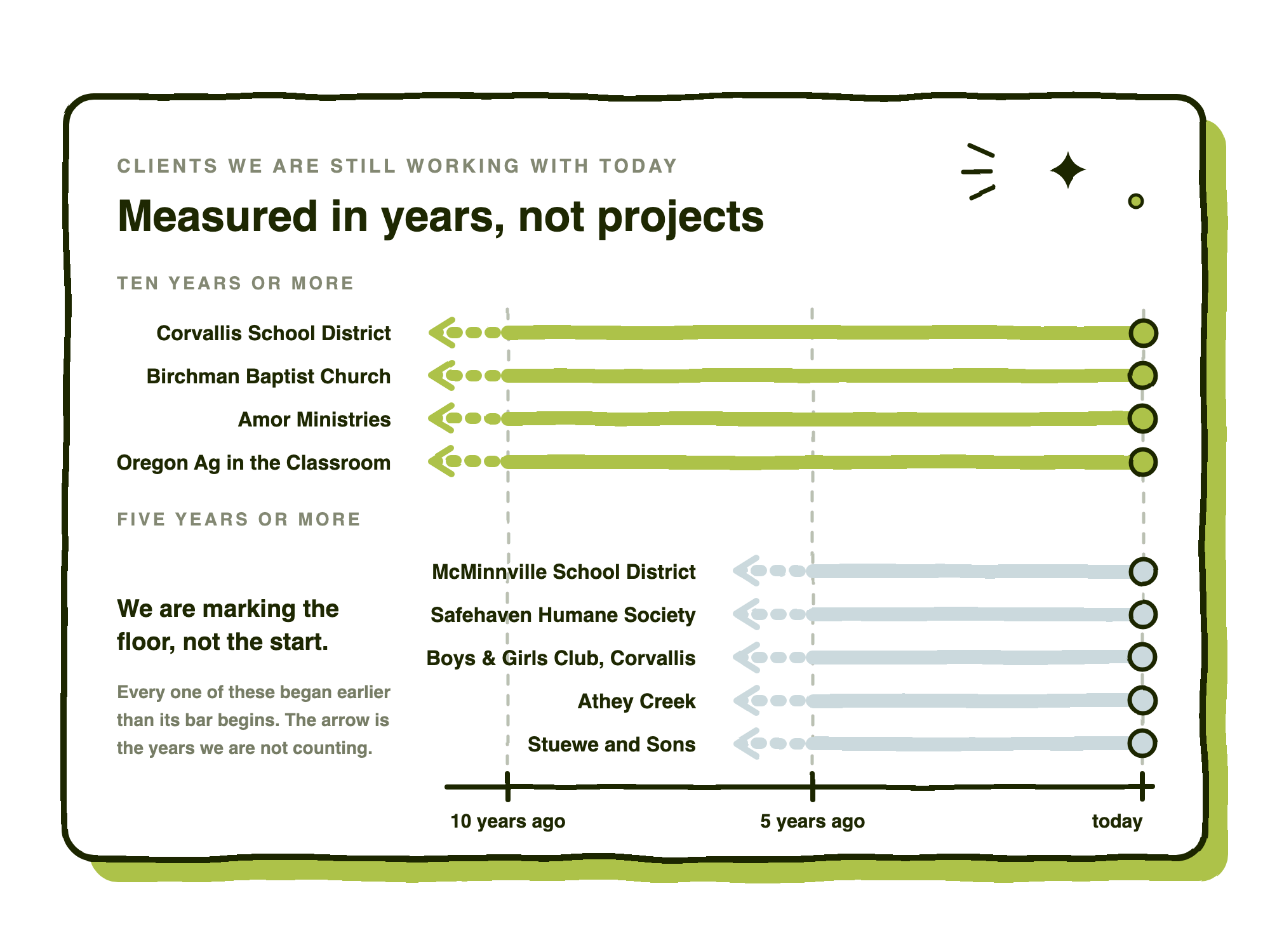
Past ten years: Corvallis School District, Birchman Baptist Church, Amor Ministries, and Oregon Agriculture in the Classroom. Past five: McMinnville School District, Safehaven Humane Society, the Boys and Girls Club of Corvallis, Athey Creek, and Stuewe and Sons.
These clients, and the length of time we have worked together, tells a story. A lesson we have learned over the years of serving our clients is all good things, all things that last, are slow and take time.
The hired hand and the household
There is an old distinction between a hired hand and a member of the household, and it is not a distinction about character. The hired hand is not lazy, or dishonest, or bad at the job. They are working to a specification. When the specification is met, the obligation is met — and when something happens that the specification did not anticipate, the correct professional move is to stop, scope it, quote it, and wait for approval.
Someone who has a long history behaves differently. They behave differently because they hold more information. They can tell the difference between a request that is genuinely urgent and one that merely arrived urgently. They know which parts of your site are load-bearing and which are decoration. They have watched you make this decision before and remember how it went and can bring that to bear when the unexpected happens or when the next request for a change comes in.
Our studio is named for this. Abide means to remain with something, to dwell, to stay. Josh chose it in 2012, alongside pastoral work at a young church plant in Corvallis, before there were any clients to stay with. It has since turned out to describe the business model more accurately than it described the intention.
What does not fit in the handoff file
When an organization changes web providers there is a handoff. Logins, DNS, design files, a brand kit, maybe the original brief. It fits in a folder and it takes an afternoon, and it is genuinely everything that can be written down cheaply.
Then there is the rest of it.
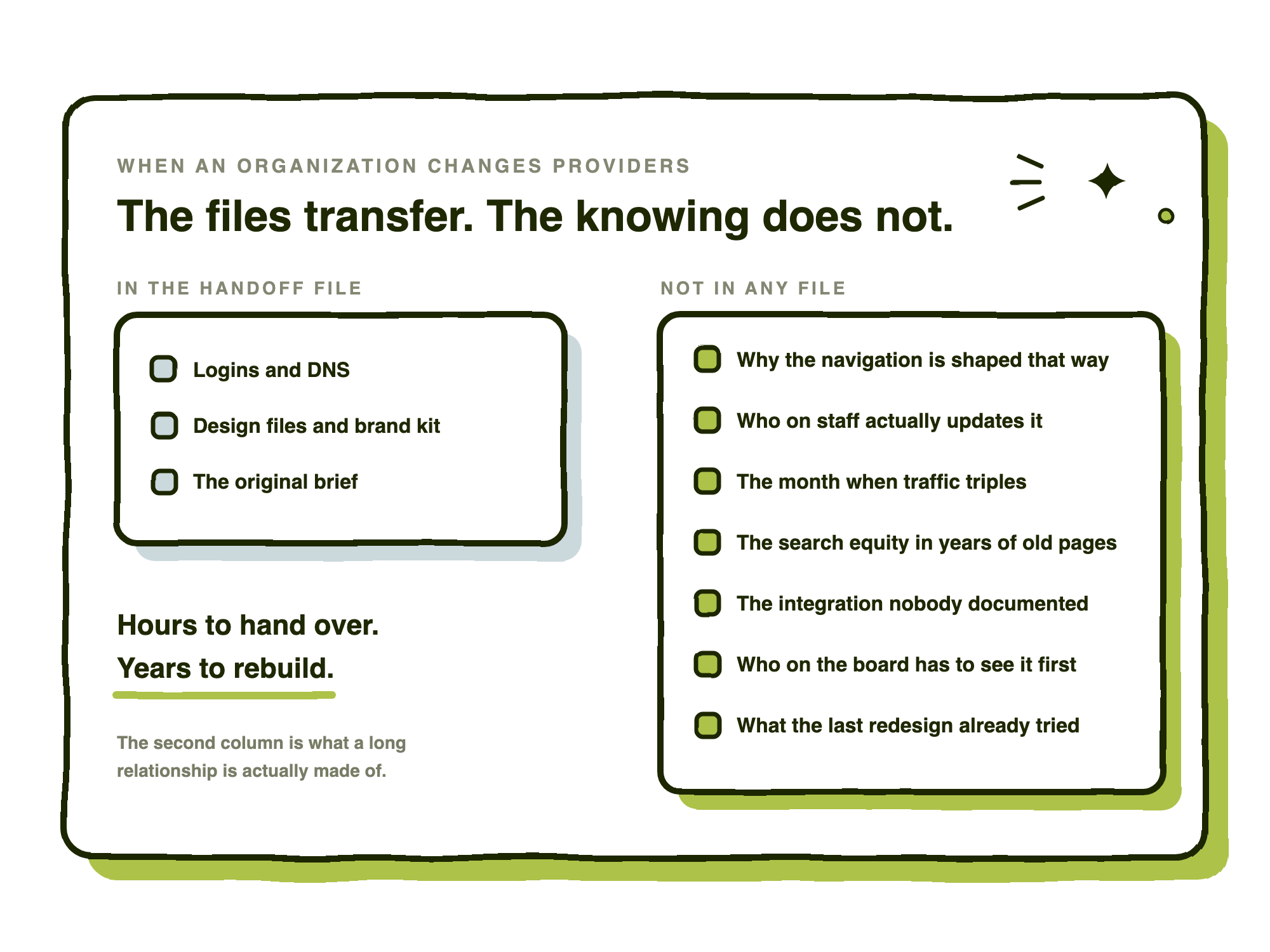
Some of the second column in the diagram above is about how an organization really operates rather than how it describes itself. The Corvallis School District site serves more than 5,000 students across 10 schools, and the requirement that shaped it was not visual. It was that the district’s communications team had to be able to post announcements, update calendars, and push emergency communications without involving a developer — at whatever hour that becomes necessary. Everything about the content model follows from that one constraint, and you learn a constraint like that by sitting with the person who lives inside it.
And some of it is structural memory. Athey Creek‘s site is not one website; its a main site plus a constellation of related microsites, teachings libraries, and event portals each serving its own audience while still reading as the same church. That is a structure you can only maintain well if you remember why each piece was added, which of them matter to whom, and which two would break if you changed the third.
One project becomes the work
The other thing that happens over years is that the engagement stops matching its original shape. Nobody plans this. A website goes well, so hosting follows; the logo is showing its age, so branding follows; a second brand needs the same treatment. Ten years later the relationship covers a category of work rather than a project.
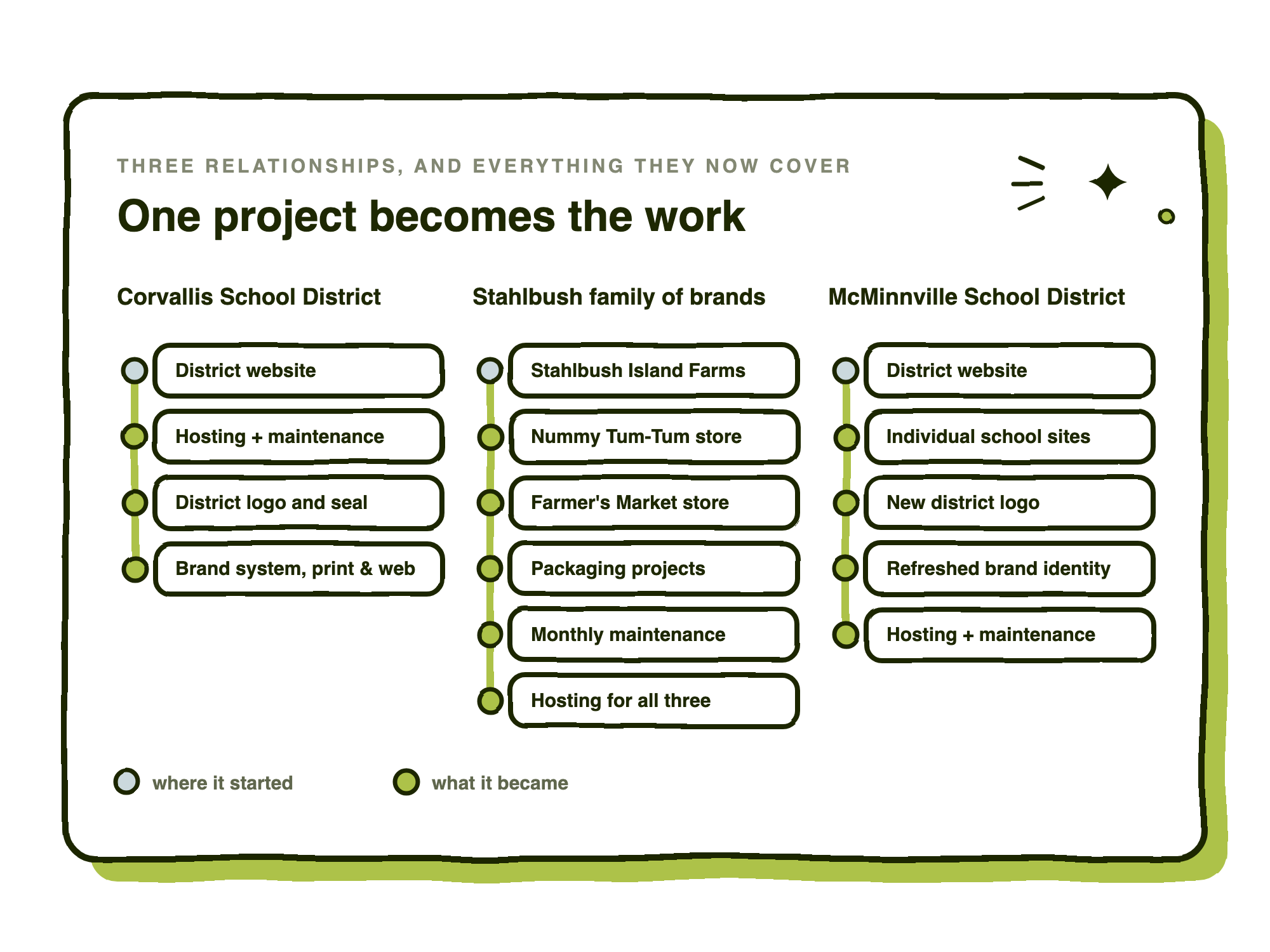
Stahlbush Island Farms, Nummy Tum-Tum, and Farmer’s Market Foods are three retail brands in one family, and we host and maintain all three. Their marketing manager’s summary of it is more useful than ours: they have partnered with us over the past few years on multiple creative projects across the three brands — full revamps of all three websites, various packaging projects, and monthly maintenance besides. The benefit of that arrangement is not a volume discount. It is that infrastructure decisions get made once, consistently, by people who have all three sites in their heads at the same time.
Trust also travels sideways in ways nobody can plan for. The New York Agriculture Map — an interactive educational resource, built for an organization on the other side of the country — came to us because a partner organization referred us for similar work they had seen. Their program manager’s closing note was about working with us on future phases of the resource rather than about a finish line. None of that appears on an invoice, and all of it is a return on work done years earlier for somebody else.
Shared language, and why it saves so much time
Every organization runs on vocabulary that means nothing outside the building. A district has a bond measure and a boundary process. A church has a series, a campus, and a livestream that starts at a fixed minute. A farm has a pack season. A distributor has a catalog that is not a product list. None of these are hard ideas. They are just expensive to explain, and they have to be explained to every new provider, every time, before any work can start.
Once that translation layer disappears, the tone of the work changes. The McMinnville School District sites were built around how their small communications team actually works rather than around how a district website is supposed to work — a distinction that takes a while to learn and is worth a great deal once learned. Requests stop arriving as specifications and start arriving as problems, which is the form in which they can actually be solved well.
This runs in both directions, and the client half of it gets discussed far less than it should. The relationships that work best are the ones where the client has also learned how to work with us:
- They tell us about the campaign before it is a deadline. A month of warning about a fundraising push or a program launch is the difference between building something and bolting something on.
- They forward the objection, not the summary of the objection. Knowing that one board member specifically dislikes the photo is more useful than knowing the board had concerns about the homepage.
- They let us say a thing is a bad idea. And we have to have earned the right to say it, which takes about as long as everything else here.
That is a skill a client develops on a specific provider. It does not transfer either.
Seeing around corners
The most valuable thing a long relationship produces is also the least invoiceable: problems that never became problems. Our hosting and maintenance page lists the mechanics, and we have broken them down at length elsewhere — backups, security hardening, compatibility testing before updates reach production. Any competent host should offer them. What is harder to buy is the knowledge of when.
We host Corvallis School District through every emergency communications event and back-to-school traffic surge. We host Athey Creek through event registration spikes and new feature launches. We step in to fill the gap for Oregon Cattlemen’s Association when they transition from one communications coordinator to another. We are there to plug holes for Stuewe and Sons when the back office api connection drops and sales are falling through as a result. None of those are surprises to us because we have been here before with each.
What we are not promising – 24/7 service
What years actually change is not the service level. It is the judgment on both sides of it. After enough time we can usually tell from a subject line whether something is a Monday problem or a right-now problem, and clients who have been with us a while have a well-calibrated sense of what genuinely warrants the call. That mutual calibration is worth considerably more than a promise neither party could keep. When one of us is away, the other covers, and we coordinate travel in advance so nobody is surprised — which is a smaller, duller commitment than a 24/7 badge, and one we can actually honor.
Trust is not the feeling that someone will always be available. It is the confidence that when they are, they will know what to do.
What it sounds like from the other side
We are obviously not a neutral party here, so it is worth reading how clients describe this themselves. The phrase that keeps recurring is not about design quality. It is about not having to think about it.
I really enjoy working with him and having him on our team.
That is Safehaven Humane Society, and the operative words are our team. The Corvallis Advocate puts it as a busy newsroom that does not want to think about its website and no longer has to. The Institute for Applied Ecology says the team is there when ongoing help is needed and the site feels like it is in good hands. Corvallis Montessori School, a newer relationship, describes being grateful for it and confident about the future — which is a thing you say at the beginning of something, not the end of it.
None of this is an argument for choosing a long-term partner over a good one. Choose a good one. But when you are holding two quotes that look broadly similar — and our pricing guide exists so you can at least compare them honestly — the question that separates them is not who is cheapest. It is who will still know your site in 2031, and whether they will be answering the phone themselves when they do.
If you want the fuller version of how we work that is what our about page is for. If you have a project in mind, tell us about it and we will come back with an estimate and a time to talk.
And if you already have a provider you have been with for years: that is a real asset and one not to take lightly. Think twice before trading it for a redesign.